Sometimes, it feels pretty good to be wrong, and Street Fighter II: The World Warrior is one of those times. With this game Capcom took everything that was awful about the original and either removed or fixed it. Then they took everything that was good about the first game (which wasn't much, but it had its decent ideas, execution aside) and made it better. That Street Fighter II was a good game was surprising, but after playing it, there was no surprise at the way it spawned an entire fighting game industry.
 The first improvement is obvious from the beginning. While Street Fighter only let you play as Ryu (or Ken if you were in two-player battles), Street Fighter II expands the character selection to eight. And while Ryu and Ken are still essentially the same fighter with different appearances, each of the remaining six choices are completely unique from one another.
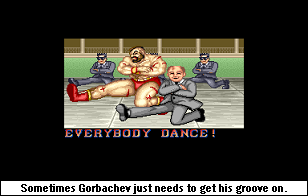
Ken and Ryu continue to rely on their special moves from the first game, but then you have Guile, who is less a martial artist and more of a street fighter in style. Which is already a step up, since now there is finally someone whose technique actually fits the game's title. There is Zangief, a Soviet wrestler covered in scars from all the bear wrestling he does in his spare time. Now that's a man (who just happens to be adapted directly from Mike Haggar of Final Fight fame). We have E. Honda, a sumo who can launch himself like a human projectile. We have Dhalsim, a Hindu ascetic whose yoga mastery allows him to stretch his limbs across half the screen. And we have Chun Li, significant more for being female than for anything else, though she can kick like lightning.
 Finally, there's Blanka, who gets Street Fighter II's "Why Do You Exist?" award. He's supposedly human, despite the greenish appearance, and he's supposedly fighting with the Brazilian martial art capoeira, but most of the time he'll be somersaulting, biting his opponent like a vampire, or generating electricity by constipating himself. Not that I'm upset he's in the game; he's a great character and fun to play. It just doesn't make much sense when compared to everyone else. In that sense we might call Blanka the father of all the bizarre characters in fighting games...those guys who always seem just a tad out of place.
The gameplay mechanics are unchanged from Street Fighter, but are actually in working order this time around. Blocking is still accomplished by moving away from your opponent. There are still six attack buttons, but now they really make up six different kinds of attacks. There are still special moves, but now they control far more tightly so it's not a debacle trying to execute one. And the entire game is now responsive. The first game was so laggy it was nearly unplayable, but the game and control speed have now been evened out to make the whole thing run very smoothly.
 Bonus stages make a return in Street Fighter II, occurring after every three victories through the single-player game. Now instead of kicking through boards, however, you have to beat a car to death with your bare hands, or destroy barrels that are falling on your head. These stages make less sense than their predecessors, but perhaps that's part of why they're so much more fun. And it's nice to have a diversion on occasion from the senseless violence the rest of the game espouses.
Not that the violence is bad - it's thoroughly enjoyable. But the story for the game is still pretty sparse. The overarching "plot" is virtually identical to the first game: it's a fighting tournament taking place all over the world to determine who the world's strongest/best fighter is. But that's not really compelling. We know that you won the first tournament in Street Fighter as Ryu, and he is therefore the defending champion, but it's meaningless within the game. To that end Capcom created loose backstories and motivations for each character. Guile and Chun Li are hunting down the game's final boss for criminal activity, for instance (Guile with the US military and Chun Li with Interpol). E. Honda wants to prove that sumo isn't just fat dudes in thongs belly bumping. None of these is fleshed out, but I give Capcom credit for recognizing they should explain the presence of all these diverse characters.
 After defeating every selectable character in the single-player game, you must fight through four consecutive boss battles. The common thread is that all bosses are members of the criminal organization Shadaloo, which is also sponsoring the tournament. When the game was released in Japan, the first of these four bosses was an African American boxer named Mike Bison who was designed to be, of course, Mike Tyson. He even had the gap in his teeth, and wore some bling in his closeup photo. Because in America that would result in a suit for copyright infringement (you can copyright a human being?), they changed his name to Balrog.
Balrog is the game's only fighter who can't kick, but he doesn't need to. He punches absurdly hard, and is pretty quick to boot. Defeating him sends you to Vega (who had been the original Balrog in Japan...this is confusing I know), a Spanish narcissist who is the only character to use a weapon. That, and he can go into the background where he is invincible (as pictured above) to swan dive on your face. Afterward, you fight Sagat, who was the boss of Street Fighter. He's now got a massive scar on his chest from Ryu's dragon punch special move at the end of the first game, and he's pretty pissed about it. Which I guess led him to join a crime ring.
 Finally, when everyone else is defeated, you fight the end boss. In Japan this was the original Vega, but because Vega was now the claw dude, America was left with Mike Bison as the remaining unused name. But does a military dictator in full uniform really strike you as a "Mike Bison?" No? What about an "M. Bison?" Yeah, sounds better now doesn't it? What's the M stand for now? Murder?
While the single-player game is superior in every way to Street Fighter's, it's the multiplayer mode where the game really shines brightest. You're bound to find a character out of the eight who is your favorite, and with six attack buttons that themselves can do 3-4 different attacks each depending on situation, there are a lot of nuances to learn. It's one of those "easy to learn, hard to master" types of games that generates a lot of really fun and rewarding competition. And the balance between fighters is significantly better than you might think. At first you'll choose Dhalsim because he can punch you from across the screen, and you'll think you're unstoppable. But then you'll realize that he's one of the slowest people in the game and is easily counter-attacked. So you'll move on to another fighter, but will find weaknesses there too. No single character is vastly superior to any other, and that's quite a feat considering it's the first time Capcom branched out beyond one playable guy.
Every character also has an individual ending for finishing the game. They range from lame (Dhalsim showing a kid a picture of him winning), to cool (Ryu skipping the awards ceremony to find more people to beat up), to downright strange (Blanka shouting "Mommy!" and blubbering like a baby). It further enriches the depth of the experience, which is one with few flaws. The only real complaints are that a few of the special moves still don't command reliably (Guile's "flash kick" comes to mind), the bosses feel like they should be playable, and the fighting can feel a bit stiff. Not laggy or terrible, but just stiff.
All that said, Street Fighter II: The World Warrior is a good game. Comparing it to the original isn't even fair. The main reason nobody remembers Street Fighter is that it was garbage. But the secondary reason is that with this game, Capcom eliminated any reason for anyone to ever play the first title again. So with that said, I think it's now time for us to celebrate in the appropriate Russian fashion.
Bottom Line: 15/20


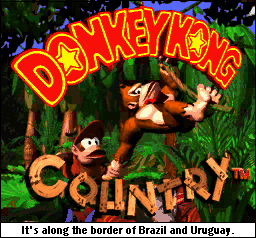 Rare decided to make a platforming game that was simultaneously true to old formulas while breaking new ground. They utilized fancy rendering technology to make the game look great, which is probably the main reason people remember this game as being awesome (it wasn't). They gave us a huge, detailed map screen, an extended credits sequence, and a truly outstanding musical score. But you'll notice that I didn't include gameplay in that list of notable positives in this game.
 Of course, then you start riding around on a rhinoceros. Occasionally in the game you will find a crate with the picture of an animal on the side. These can be the rhino, a swordfish, a frog, or even an ostrich. They all have special abilities that are supposed to aid you. I say supposed to, because often you'll end up screwed due to the difference in how they play. For example, when riding the ostrich, you can't jump on enemies anymore. But that's all you do in the game so how was I supposed to know? So I jump on an enemy and my ostrich gets hurt and runs away. And now I'm flashing temporarily invincible because the game doesn't want me to get hit multiple times in a row. Which is normally respectable, but I can't interact with anything on screen (enemies, objects, etc) during this time period. In fact, I even clip through enemies. So now when I try again to jump on that same enemy because I'm no longer a worthless ostrich, I go through it. And then the invincibility wears off and the game says "Hey, you're standing in the enemy. Unacceptable." And you die. I wish I could say this kind of glitchiness is infrequent, but it's not.
 The functional difference between the two is fairly clear. Donkey is heavier than Diddy and can therefore kill more enemies by jumping on them than Diddy can. Diddy will usually just bounce off these enemies (more often than not straight into a bottomless pit). Donkey attacks with a somersault, and Diddy with a cartwheel, though this is meaningless since you never use these attacks anyway. That said, Diddy is faster than Donkey, jumps higher, and his smaller frame helps him avoid hits that much easier. As a result, throughout the game you will virtually always want to be Diddy, unless you are forced to be Donkey for certain enemies or situations. How sad is it that he's not even the best character in his own game? And when you have both, the one you aren't controlling follows you around, ignoring physics entirely. He'll float in midair, phase through objects, you know, whatever suits his fancy at the time. It's like they weren't even trying.
 For example, barrel blasting. There are a significant number of stages in this game devoted to shooting yourself out of barrels and into other barrels. It sounds like it might possibly be entertaining, but don't be lured in. The occasional barrel launch is fine, but the stages devoted entirely to the cause belong in a vault, never to be played again. You shoot yourself out of automatically-rotating barrels, having to press the button at the right time to go where you want. But the timing is screwed up and it will frequently rotate the barrel an extra notch (even a notch backward) when you tell it to fire. Which of course kills you. If you manage to get it right, you'll end up in another barrel to do the same thing. Or maybe in one that fires you automatically into oblivion. That's right, there are times you can jump into a barrel and it will automatically kill you. No thanks.
 But then again, these are the same people who decided to champion the water stages and make them even more intolerable than their predecessors. Mario can shoot fire underwater. Sonic can still just spin into stuff and kill it. The Kongs? They can die. And die repeatedly. You can't touch anything down there - it all kills you. Thank goodness you don't ever have to breathe despite being a land mammal not known for swimming...I'm so willing to take any handicap I won't even question it. If you're lucky you'll find the swordfish to ride around on, so at least you can kill some of the enemies, but only from head-on, and the worst enemies remain invincible. It's an underwater gauntlet that you just want to be over.
 And let's not forget the wonderful cast of characters. The original Donkey Kong has actually aged quite a bit, and is now sitting semi-crippled in a rocking chair, going by the name of Cranky Kong. Way to reinforce stereotypes, game. That means you are actually Donkey Kong, Jr. all grown up. Save points (which are your holy grail as you play) are run by your girlfriend, Candy Kong. And there are airports to get you from area to area, run by this dude, who is, like, more than happy to announce his name to anyone passing by. Who came up with this stuff? There's even an orangutan in some levels (including the ones with no lights!!) that incessantly hurls barrels at you, and the credits list him as Manky Kong. What? Are they related, or is every simian a Kong by default?
 The enemies in Final Fight consist of members of the Mad Gear gang, with the common thugs being the game's bread-and-butter enemies and the higher ranking members acting as area bosses. The enemies all look distinctive, be they wearing a belt covered in knives or a neo-punk getup. But why is Andre the Giant in this game? They call him "Andore" so don't act like it's coincidence. Not that I'm complaining - Andre the Giant is welcome in any video game at any time for any reason. But it's certainly a bit random, particularly in that ruby red leopard print he's got going on there.
 As Haggar's daughter is being held on the other side of town, the game's direction consists in moving eastward across Metro City through various districts and locales. Usually there's some sense to this, with each stage being subdivided into several smaller areas that all reasonably connect to one another and provide a believable change of scenery. And then, sometimes, you simply appear in a wrestling ring with no explanation, fighting an armored, two-sword wielding dude whose name really gives you some motivation to not let him knock you unconscious.
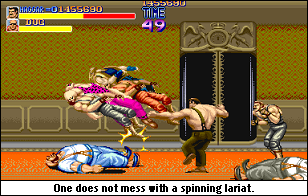 While every character can attack and jump, and even attack whilst jumping, they all have a special attack as well. The special attack costs health to use, with the amount of health lost dependent on the number of enemies hit with it. As such, it's primarily a tool for getting out of a tight spot, and not to be used liberally. Guy's special move is something a little too similar to Ryu's hurricane kick from
 But you know who doesn't have a problem using weapons? This guy. By this point the question starts to enter your mind about just what sort of gang Mad Gear is. Their bosses have included a samurai, a couple giants, and now...a military dictator? What? And how is he not the last boss? You'd think being the dictator and all, he'd be unlikely to be anyone's subordinate, but that's clearly not the case. And maybe that's what's angering him enough to flip around lobbing infinite numbers of grenades at you. Don't be fooled by that nightstick he's got there. I've only seen him actually attempt to attack with it once. No, Rolento is set on making you explode. Dead set.
 Well, I hate to break it to you, but you're looking forward to a fight with a dude in a wheelchair. As if that's fair. You go through this whole game killing a veritable army of knife-throwers, barrel-rollers, and Andre the Giant clones, and when you're ready to put the pain on the dude in charge, he's a cripple? How dare you make me pity my last enemy! And he's a vicious little bugger too. He takes that moment of quiet hesitation and reflection on life's meaning to whip out a crossbow and start a-firing. You know why he has a crossbow? Because he can't shoot a normal bow in that wheelchair of his. See? How's that feel?
 Dude means business.
 So rather than show you screenshots of the game's action, which admittedly looks cool on its own, I decided I would show you the painful reality of this game as best I could. A major premise of the game is the collection of powerups - Samus' body armor was designed by a birdlike alien race known as the Chozo, who had once inhabited Planet Zebes, and left behind statues with suit modifications on them in case they ever returned. So Samus can steadily gain these throughout the game, becoming more powerful.
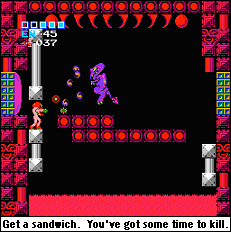 In fact, when you enter through that door on the right, you will likely drop to the platform directly under it to try to shoot him. It's the most reasonable place to go, right? But then you realize you can't shoot through those purple ball things he's firing, so you have to get up on his platform. But you can't jump up there. You know why? Because the door closes and juts out above your head. Seriously! You will drop into that acid stuff because the freaking door was designed to screw you over. If you DO manage to get on the platform, the purple crap usually launches you back deeper into the acid, which constantly drains your life. I honestly have no clue how I got to the place I'm standing in the picture. What I do know, however, is that if you are on that point with the most powerful gun in the game, Ridley can't hit you at all, and you can shoot him freely.
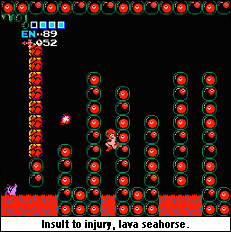 And what about this crap? You get knocked back when an enemy hits you, which is fairly standard. But why make this spot that you can get knocked into with absolutely no hope of escape? I tried everything. Jumping out, shooting out, bombing out, even trying to submerge myself in the lava and go under the pillars, but none of them worked. Instead you just get to sit there and watch all your health slowly evaporate until the game over screen. How is that in any way fun?
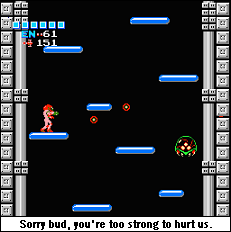 Then there are the metroids themselves, which you honestly by this point begin to believe don't actually exist at all. They're freaky jellyfish things that latch onto your head and suck life away almost as quickly as this game sucks your soul. You have to lay bombs inside them to get them off for a second, but one isn't enough! Imagine someone put a bomb inside your throat. Would you stop whatever you were doing? Of course you would, because you're not ridiculous. This game is. And what's worse, if you've been putting in the effort and time, by this point of the game you have the most powerful weapon upgrade. But guess what? Metroids are immune to it. Fooled you, huh! You have to go all the way back to a totally different area of the game and downgrade your weapon to even have a chance of surviving the encounter.
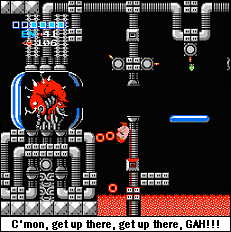 Now we've all probably seen shots of the final showdown with "Mother Brain," the leader of the Space Pirate forces (none of whom are even present at any point during the game). It looks simple, and possibly fun, standing on that pillar shooting missiles into the brain until the whole place explodes and you win. What I am showing you instead is the horrible truth behind that fight. The fact that there is so much crap shooting you that you will inevitably fall into the lava here. You'd like to jump back up to where you were, but that's not possible. It's too high. Instead, you have to jump up to the platform where Mother Brain is. But if you touch the glass, you get shot back down into the lava. If you don't touch the glass, something will likely hit you, so you fall back into the lava. The entire fight revolves around trying to shoot a stationary target while escaping a lava pit right next to it, and it's hard as hell. Who green-lighted this thing? And naturally, missiles are the only thing that hurts it. If you run out of missiles during the fight (or even before it, because you have to destroy 5 walls with them on the way...that constantly regenerate), guess what? You're boned. Can't win. Go die. Come back with 30 health. See how you do then.
 Then, when you finally do manage to beat the thing, the whole base is set to explode and a countdown timer appears for you to escape. The escape route consists of tiny little platforms that you have to jump to. But jumping is far from precise in Metroid, so here you are trying to methodically jump from tiny platform to tiny platform, often falling, while a timer counts down to your death. If you die, guess where you start? Yeah, with 30 health before the boss. Fight it again. I don't think it's a coincidence that the happiest-sounding music of the entire game plays during this escape sequence. The game is genuinely elated that you're going to die and have to redo everything. And if you DO get out of there, you get a screen saying, in broken English, that you succeeded and there's peace. Sike! Just kidding, there's not really peace, but you can pray for it if it'll make you feel better. What a load of horse manure.
 I'm going to kick this review off by ruining the ending for you. You ready? You ready?! Glance to the right. BAM! Ending spoiled. And that's the good ending. There's actually a worse one if you don't collect all the chaos emeralds during the game, which I'll talk about later down the page. This ending was too awesome for the cartridge label or title screen, and can only be earned by beating the game like a consummate pro. That's the kind of dude Sonic is, and you'd better get used to it. There are even multiple paths through every single level in the game. Make your own rules. Sonic does.
 The game is a side- scrolling platformer, but is designed on most levels to be played quickly. By that I mean Sonic can just run, at blazing speeds, through each level without stopping so long as he's not getting hit or running into walls. Need to run upside down a bit to accomplish this, or up a wall? No problem. Just run fast enough. The earlier stages especially allow this. And the powerups on each level consist of different items sitting around inside television screens, which can be accessed by destroying the television set itself. Sonic the Hedgehog rewards vandals. But I guess "stage" and "level" aren't the right words. Sonic has "zones," which are each divided into three "acts." So classy.
 The variety of each zone's design will be immediately apparent. The backgrounds are different, of course, but so are the enemies, obstacles, and style of gameplay. Some zones are covered in springs, which launch Sonic high into the air. Some have lightning orbs pulsing electricity out. Some have giant pools of lava. It really helps the game retain its fun factor throughout the entire experience.
 To that end Sega is diligent about trying to include ample opportunities for you to breathe. You can jump out of the water, of course, but most of the time you'll be looking for bubbles. Stand atop the bubble area long enough, and eventually a large enough bubble will emerge that Sonic is able to "breathe" it in and replenish his oxygen supply. Which brings me to a larger question: Why make him need to breathe at all? I suspect the rationale was that it would lend an extra degree of realism to the game, or perhaps extra challenge and urgency. But with so many bubble areas all over, the urgency isn't there. And why would you seek realism in a game with a blue hedgehog breathing bubbles and running almost as fast as the speed of sound?
 If you are in possession of at least 50 rings by the end of any given act (except boss acts and the final couple zones), a gigantic ring floats above the level's end. Jumping into it accesses a constantly rotating bonus stage in which Sonic curls up into a ball and tries not to vomit all over himself, while simultaneously attempting to acquire a gem called a chaos emerald. Having all the emeralds grants obscene power, so Sonic has to get to them before Dr. Robotnik can. The bonus stages are pretty strange, but I have to admit they're enjoyable once you get the hang of them. I just hope you aren't someone who gets motion sickness easily.
 Each zone culminates in a battle with Dr. Robotnik, who always has some new device and/or attachment to his hovercraft to foible your attempts to stop him. It's cleverly simple - you attack him the same way every time (by jumping into him), but because you're avoiding different weapons from his machines, the timing and tempo change up. Each boss battle is actually a good time in itself. The good doctor even punks you at the end when you think you've reached him in his own factory. He flips a switch that drops the floor out from under your feet and sends you into...another water level. Touché, sir! It definitely makes his final defeat a good deal more satisfying.
 Mario had the name, the selling power, and was the unquestioned king of video games at the time. The first two Super Mario Bros. games were already out in America, and Japan had The Lost Levels and even Super Mario Bros. 3 to play. The guy's name was as good as gold. By putting his mug on a Game Boy launch title, it wouldn't matter if the game sucked or the whole console sucked - both would sell. It's a prudent marketing strategy, really. And while it's not exactly fair to say Super Mario Land sucks, it would certainly be a stretch to call it good.
 If you've ever taken trigonometry or calculus, and the screen at left seems eerily familiar, it might be because someone in your class was playing it on his or her graphing calculator. That's right, a TI-83 could in essence run Super Mario Land. Clearly part of that is the fact that, like any console, it takes several games to figure out how to get the most out of it. But I feel like they had to have been able to do better than this, right? And what's with that enemy? There's a piranha plant which is well and good, but what is up with that prancing colonist? The worst part is that he doesn't even die when you jump on him. It just stuns him, and he keeps following you. Creeper.
 The game's story is pretty incomprehensible. Mario is out to save Princess Daisy, who doesn't seem to have any relation whatsoever to Peach, from her captors. But her captor isn't Bowser; I'm not really sure it's anyone. The enemies all seem totally unrelated, as do the worlds. And half the boss fights are just total clones of the Super Mario Bros. Bowser fights, including the "bridge release" switch or whatever it's supposed to be. So why not just make it Bowser? Why this Sphinx thing? What's the Egypt motif actually accomplishing here?
 There's also a whole world dedicated to aliens for some reason, and another one on Easter Island. They even replace the flying Koopa Troopas with - I kid you not - winged Easter Island heads. Why? Speaking of Koopas, when you jump on one in this game, they detonate. Yeah, like a bomb. I don't know why either. I have no answers for you.
The game is mercifully brief, at least. Whereas Super Mario Bros. had 8 worlds with 4 levels each (32 levels total), Super Mario Land has 4 worlds with 3 levels each (12 levels total). Throughout most of them there plays a catchy little ditty that you may have heard
 The game does commendably try to shake things up a bit by including two vehicle levels. The first of these uses a submersible pod that fires torpedoes at everything in your way, and the second is an airplane that works in exactly the same way. These levels are interesting and more fun to play than the standard ones, and have special bosses that you fight within the vehicle. This game almost works better as a sidescrolling vehicle shooter than it does as a Mario game, which is pretty sad when you think about it.
Some of the gameplay mechanics are unusual as well. For instance, often times if you run or jump straight into an enemy (rather than on top of it), the enemy will still take a hit and die, though you'll take damage. It's not really one or the other anymore. Bullet Bill launchers can now emerge from pipes, and the bullets themselves cannot be jumped on or killed. Mario's fireballs now also act like boomerangs, and can collect coins for him. One change I liked: if you're jumping when you get a super mushroom (the ones that make you big), your momentum doesn't stop. In Super Mario Bros., getting a powerup in midair was a virtual death sentence, which wasn't too fair.
 At least the princess this time around actually appears to have been worth saving. Not only does she thank you unconditionally, but she also runs straight over to you and gives you a little heart affection. Taking notes here, Peach? The hilarious thing is that, as Nintendo would later reveal, Princess Daisy is actually the girlfriend of Luigi. Mario's younger brother. It's unclear whether that happened after Mario had had enough of her, or whether he was just taking advantage of his brother's absence. But this is arguably the first instance of Luigi-prejudice...a theme we will see slowly develop over time throughout Mario's game library.
But back on point. Super Mario Land is a quick game, which is wholly a good thing. It looks ugly, plays ugly, and doesn't feel too Mario-like, which is obviously unacceptable for a flagship Mario game to launch a console. But it succeeds a bit in the vehicle stages, the music is too catchy to ignore, and you're never too frustrated as you play, which can be a rarity amongst Mario games. Overall, it's pretty much a completely average game.
Bottom Line: 10/20

