So it was into this landscape in 1996 that Tomb Raider burst onto the scene, making no bones about putting its players in the shoes of archaeologist/adventurer Lara Croft. It's as though it was telling players "You're going to play as a woman, you're going to be a total badass, and you're going to like it." This was a big deal at the time, and really helped push for a new level of gender equality in games. This is all very positive stuff. But none of it speaks to what Tomb Raider as a game was really all about. And unfortunately, when you get right down to it, Tomb Raider is a game that feels like it's not really sure what it wants to be. It tries to be a story-driven adventure game, and it almost succeeds. It tries to be a third person shooter and it almost succeeds. It tries to be a 3D platformer and it almost succeeds. But by trying to be all three at once, it falls short of being any of them. Let me show you how that ends up working out.
First off, the story. When you start the game, you don't even know what it is. You might check the printed manual that came with the thing, but all it tells you is about Lara's background - she was a stuck up, rich English girl who got lost in the wild for a spell, and over that short period of time learned every survival skill in existence. Cool, I guess, but now what? The game opens with an incomprehensible cinematic showing some explosion, then cuts to Lara in some house (Is it her house? Someone else's? We'll never know.) talking to a hick and watching what looks something like a Nintendo DS as she's told about an artifact in South America. And that's it! Next thing you know you're in a cave and the game's begun. What's my motive, man?!
 So off you go, cavorting (some might say raiding) through tombs, looking to claim some mythical artifact you've never heard of solely because it might be there. As you go, you'll encounter some of the same characters from the opening cutscenes again, though if I'm honest you will rarely realize that's who they are. These characters mean nothing to Lara as a character and even less to you as a player, and the game doesn't make any effort to change that. So when hick dude ambushes you after you get the artifact and tries to steal it, there's no big sting of betrayal. You almost don't even realize it's the same guy. You're just going "Oh, this redneck wants my loot. I guess I'd better shoot him."
That mindless decision to solve problems by shooting at stuff is a running problem through the game, and we'll get to it shortly. But perhaps the most infuriating thing about the story is this: it eventually gets good! It takes until the final few levels but the story eventually makes sense and it's pretty well thought out and intriguing. But where was that the entire rest of the game? And I don't mean to say the story is boring for a while but then picks up near the end. What I'm saying is that there's no story at all until the very end of the game, when a story is laid out that puts the entire game into perspective. They give you retroactive motivation for clearing the levels you've already beaten. You start to go "Well hey! This all meant something and that's pretty cool!" But wouldn't it have been nice to have that along the way? I mean, you had the material! You clearly planned it out and wrote a decent narrative! Why did you deny it to me for so long?!
Then again, I suppose that even if they did string that story out over the whole campaign, it would have been hard to take seriously. Suspension of disbelief would be destroyed with nearly every room you entered. By that I don't mean with the nature of the enemies, or even the lingering implication that an aristocrat lost in the wilderness with nothing but a will to survive would manage to become an akimbo pistol expert before being rescued. It's the smaller things. It's the way those two pistols have, conveniently, an infinite number of bullets inside and require no reloading mechanism. It's the way the other weapons you find have ammunition liberally distributed around the environments you explore, which of course are supposed to be ancient tombs sealed away for thousands of years. It's the way your tiny backpack can hold dozens of medical packs that will instantly cure you of gunshot and other wounds. When you look at it, these are the conventions of shooter games. While you, the player, think you're playing a story-driven adventure, Lara Croft is 100% sure she's stuck in a shooter game, and she acts accordingly.
 Exhibit A: This is the most typical sight you'll see during your adventures in Tomb Raider. Most combat in the game revolves around Lara finding some kind of high ground, seeing some number of wild beasts down below, and shooting them like fish in a barrel. Nothing is off limits here. No creature is safe. In this picture is one dead lion, a second soon-to-be dead lion, and a gorilla running for its life. That's smart of the gorilla, considering that Tomb Raider nearly put the species extinct. In one level alone, I killed 19 gorillas. NINETEEN! Why are there 19 gorillas in this ancient tomb? And why does Lara Croft, an archaeologist who supposedly wants to conserve things, not even hesitate to eradicate them with deadly force? You could argue that, if given the chance, the gorillas would attack her, but what threat is this guy posing? What's he going to do from 15 feet down in a pit? There's just no call for it.
It's not just the gorillas, either. The more visually astute among you will have seen the dead alligator floating in the water in the picture some paragraphs above. You know how you kill alligators in Tomb Raider? You stand up on a ledge and shoot into the water while they're swimming. Here's some other helpless animals you'll fill with lead from up on high ground: wolves, panthers, rats...the point is that this is basically all you do. The only animals you aren't shooting down at are bats, though that doesn't put them any less on the receiving end of your gunfire. As a player it starts to get a little boring. There's nothing exciting about firing your infinite bullets into a creature that can't even defend itself against you, and it begins to feel like the game is just throwing these animals your way just to keep you busy. You become numb to it all.
 Say, here's a thirsty bear making its way to a small pool for a refreshing drink of water. Rationally, I know that I'm in the buried ruins of a city and civilization long forgotten. I know that nobody has been down here for hundreds of years or more. I know that somehow, against all odds, this bear has managed to survive in a caged off room that I only just opened. I know that this is the only source of water it's got, and its very life depends on just getting a little bit of that water to keep it going just a while longer. I know that I can simply run through the now open door and continue my quest, having given this bear a better shot at life. I know that, once my quest in this place is over, the humane thing to do would be to find a way to release the bear completely; to let it back into the wild where it can thrive and the balance of nature can be restored.
Nahhh, let's shoot it.
Not even your human enemies can figure out how to exist properly in a three dimensional environment. Case in point: during your entire second mission in the game, which spans several individual levels, you are periodically confronted by a man with a gun. It is never explained how this man continually gets in front of you as you navigate the tombs, or even how this man is otherwise integral to the plot, but that's not the point. The point is that he will appear and begin shooting at you. You must return his fire and hurt him for a while. "A while" is vague, because he seems to be programmed to take a bit of damage and then simply disappear. Once you've hurt him "enough," all you have to do is look away from him, whether by turning around or by putting a wall of some sort between you and him. Then he will just be gone. It's kind of neat, I guess, but here's the problem: his AI is super dumb. SUPER dumb.
What this guy does is run up directly to you, firing the occasional shot, until he accidentally bumps into you. Then he turns around in circles, forgetting what he was doing, only occasionally looking your way again for a quick potshot. So when you hurt him enough, he doesn't always just run off and disappear like a good NPC. More often you have to do that work for him by turning around like you're playing hide and seek with a four year old. And if platforms get involved, you're screwed. I once encountered this guy and sat on my high ground like always, shooting endlessly into his chest. I was surprised at his apparent intelligence when he then came around and walked up the ramp to my little spot to assault me. I figured I'd sit there and exchange some point blank shots for a while; I could always just heal through any damage he dealt me. Except it never freaking ended. Up on that little platform with me standing there, he had nowhere to leave my sight and no idea how to disappear; he was unable to just jump off the platform and flee, and he couldn't remember how to use the ramp anymore. I tried then to jump off the platform myself onto the ground five feet below and give him his chance at escape, but the poor guy's mind was already broken. He was an immortal, forever doomed to spin in circles, confused about how to end his existence. Ultimately I just had to load a saved game.
 So we've established that platforms of any height are unassailable bastions of safety - impassable obstacles your enemies cannot hope to overcome. But what about you? After all, when you're not blazing down the latest endangered species on your hitlist, you basically spend the game exploring massive ruins and tombs, and that consists largely of 3D platforming. It would help if that were fun or manageable, right? Well here's the thing - it works, but only if you've done the tutorial. I can't stress that enough. With the tutorial complete, navigating platforms in Tomb Raider is logical and occasionally enjoyable. If you haven't done the tutorial, platforming is an impossible guessing game of jump timing. I was shocked it made that big a difference, but it really did. Of course, I didn't even know the game had a tutorial at first, and that's part of the problem; they just stick it on the main menu with an icon of a Polaroid picture and the label "Lara's Home." What does that sound like to you? A bit of background lore perhaps? Maybe a concept art gallery? Even a guided tour of her mansion? Wrong. Platforming tutorial. Come on!!
Even once you understand the controls and spacing enough to make the game playable, platforming has its rough edges. There's a notable spot where, in order to get a powerful weapon, you must first tiptoe to the edge of the platform you're on, then slowly turn around, then say "Oh hell, here goes nothing" and take a backflip of faith to land in the area with the gun. This shouldn't be a thing. This stuff is exacerbated by the game's camera work which is, in a word, bad. It just does whatever it wants, whenever it wants to. You can't even adapt to it by trying to avoid certain spots depending on the layout of a room. It'll just let you find the place you want to stand, then zoom up right in your face and sit there. You can't control it. Don't even try.
There is a simple pleasure and peace though to be found in just wandering the game's large environments. Even if the camera is bad and the platforming a little finicky, the level design itself is superb. There are numerous times during the game when you'll feel completely lost or stuck, but you always realize deep down that you aren't; you just have to explore a bit more. Try to find a way up to a ledge that looks unreachable. Find a hidden passage in a wall or under the water. Once you hit that "eureka" moment, it's profoundly satisfying. That makes the experience worthwhile as a whole. That, and the fact that if you try to use a key on a lock it doesn't fit, Lara will straight up tell you "NO" in that snobby British accent of hers. For those two things, it's worth the story frustrations, and it's worth the mindless massacre of everything that moves. Heck, as you look above you'll notice we're not even dealing with real animals by the end. The game sort of gives up and just turns into Doom along the way, and that's OK. PETA was probably upset enough with the whole thing as it was. I mean, with everything else you'd killed, what else was even left to surprise you? Dinosaurs?

All right, I think we're done here.
Bottom Line: 12/20


 Mario 3's plot is (barely) more involved than earlier games in the series. First, the Mushroom Kingdom has been expanded to the Mushroom World, with seven other kingdoms populating the region/planet/whatever it is. What's particularly notable about these other seven kingdoms is that they all have kings. I mean, the fact that Princess Toadstool isn't Queen Toadstool tells us that at least one of her parents must still be kickin' around somewhere, but clearly they're not doing anything if they let her get repeatedly kidnapped and put the responsibility of actual rule on her shoulders. I wish I could say Mario 3 was a quest to find the Princess' deadbeat dad, but alas. Perhaps that's an idea for down the road.
 Which brings me to the first huge difference between this game and its predecessors: items. Not only did the game add far more power ups than just Super Mushrooms and Fire Flowers, but it also implemented an item storage system, by which you could hold a large number of power ups and save them for use before any given level down the road. You receive these items typically from Toad Houses, which is where the Toads seem to live when they're not suffocating in sacks in random castles. This makes the Toads really useful, which is a bit of a shock when you remember that the only previous time a Toad was any help was in Super Mario Bros. 2, which of course took place entirely in Mario's head. It's not unreasonable, therefore, to call the existence of these Toad Houses Mario's dream come true.
 The Princess isn't slouching either. She'll mail you a few different things, but none more effective than the "P-Wing," or Magic Wing, which gives Mario the same power-up as a Super Leaf except that for the entire next stage he can fly infinitely. That's great for situations like the one at right. Where's Mario in that mess of death? Flying a safe distance above it, that's where. No need to put yourself in harm's way, man. Be cool. I could go on about the various power-ups, but there's just so much new stuff I can't hit it all. Mario's even got new basic abilities, like picking up and carrying around the shells of defeated koopa troopas. There's so much new stuff that the game manual literally dedicates four entire pages to covering Mario's moves, and doesn't finish the job before giving up.
 ...But not quite as terrifying as an ice kingdom. Look, I get it. Each of these seven kingdoms needs to be somehow distinct for gameplay and design purposes. It's understandable. But when I rescued the king of Water Land and gently reminded him that his sovereignty was an oxymoron, I thought I'd seen the worst the Mushroom World had to offer. What could be more heinous than an entire nation of water levels? And then came Ice Land. "Say, what if we took all that water and just, like, you know, froze it?" DIE. That's the worst idea of all time. You spend your lives in Ice Land slipping and sliding down pits, into enemies, and generally into the inescapable depression that accompanies your glaring inadequacy. They give you the occasional fire flower so you can melt some tiny bits down, but it's not enough, and by then the psychological damage has been done.
 As would be expected, the end of the game has Mario taking on Bowser in his home region. Also perhaps as expected, the reason for Mario going there is that Bowser used the distraction of the first seven worlds to kidnap the Princess. That's right - Bowser was in it for the long con and never took his eyes off that sweet sweet prize. So maybe it's guilt that drives Mario forward; the Princess did, after all, dutifully mail you helpful items (though hell if I know what those cloud or music block items were). The least you could do is make sure she's not going to end up mothering more Koopalings. Or maybe it's just good old fashioned lust. Who knows? All I know is that Bowser has his place defended better than any legitimate kingdom in the Mushroom World. You have to work through a procession of tanks, a navy of warships, a series of fast battles against some harder enemies, and a fleet of airship bombardment platforms. And then you hit the first actual level. His castle even has statues of himself that shoot lasers out of their eyes at you. Dang, Bowser!
 So you'd think that after fighting a multitude of new enemies, working through eight total worlds without being able to save (thanks, NES), and solving all sorts of clever design puzzles as you went, that you'd get some sort of reward for your efforts. Nope! Here's the Princess laughing at you and saying bye. And yes, that is the actual end of the game. There is no "second quest" or harder run-through or World D-4 or any other such nonsense in Mario 3. You beat the final boss, you're done. Congratulations! Now escort this wench home. I feel like whatever else Luigi's faults might be, he wouldn't stand for that. Remember Princess Daisy from
  And of course, the fine folks at Apogee Software misspelled his name on the title screen. Apparently they became aware of a
 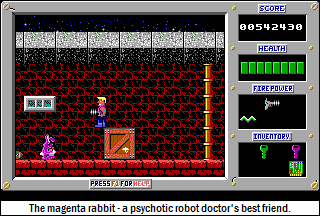 And oh yeah, why not? Magenta bunnies. For a company so deathly afraid of copyright lawsuits you'd think they'd be a little less obvious about ripping off Dr. Wily's
  That said, spikes. Well, not spikes per se...these are more like jagged broken PVC pipes more than anything else. They don't make you instantly explode, at least. Touching them will drop one bar of health, as will being damaged by any other hazard or enemy. The game is pretty generous with how much health you get and how much it provides, so even though the maps get more dangerous and the challenge increases, the game never begins to feel unfair. There are only two things in the game that can't be hurt by your little squiggle shooter, and both of those are easily avoided. When the rest of the game feels appropriately difficult, you find yourself not particularly minding the occasional spike-like surface.
 Episode 2 sends you to Dr. Proton's moon base. This is where I start having some issues with what's happening on the screen. First off, how the hell are you alive?! You're not in a shelter or anything; that moon base is open air. Or perhaps more appropriately, open nothing. In
 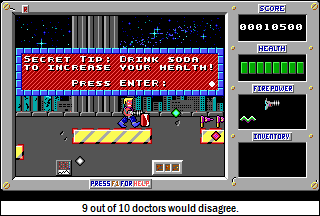 Perhaps the most charming thing about this game is that it has a conscious disinterest in taking itself seriously. This is most obvious in the various pickups you can collect, which either give you health or points. Chosen seemingly at random, they consist of cans of Coke, footballs, purple pennants, turkey legs that turn into entire turkeys when you shoot them, joysticks, and copies of the Duke Nukem game itself. It's a bit meta but that's what makes it great. When you shoot a can of Coke it will actually launch in a fizzy explosion. Where else can you find programming that specific in this era?
 As for that final boss, well. It's Dr. Proton, as you might have expected. As you might not have expected, this maniacal cyborg is actually stuck in a hoverchair - 1997's super futuristic version of a wheelchair. We've been down the last-boss-is-handicapped road before,
  The first and most obvious change is that for the first time a game with "Super" in the title actually had "super moves." Each fighter has a meter at the bottom of the screen that fills as the character strikes with a basic attack, is struck with a basic attack, uses a special move, or is hit by a special move. The supers themselves, without exception, consist of enhanced versions of special moves. For example, Ken's super is the Shoryureppa, translating to "repeating Shoryuken." Which is good, since that's an accurate description of the move. Likewise, Dhalsim's super "Yoga Inferno" is just a bigger and longer version of his Yoga Flame. This probably was done to enable Capcom to, you know, make the game in five months. So there's not a whole lot of visual impressiveness about the super moves, but from a gameplay standpoint they're a nice touch.
 Finally, the other new additions are basically both ideas stolen from
  The problems with Taz-Mania begin on the opening menu itself. Once you get past the initial three selections of Start Game, Enter Password, and Game Options, your controls on the menu are reversed. Up becomes down, left becomes right, and vice versa. There's a good omen. Why would you do that? Is it because the toilets flush the opposite way in Australia? Do Australian games naturally reverse your controls? I'm not sure, but I know that when you actually start the game things don't get much better.
 And you know what you quickly find out as you play Taz-Mania? This game is a stereotypical platformer. That's not a condemnation in itself, but let's take a step back and think about what we're working with. What's the first image that pops into your mind when you think of Taz? Is it him spinning and making crazy noises, or is it him jumping around collecting diamonds and floating numbers for points? Probably the former, right? Well great, because this game will give you almost exclusively the latter. Look, I'm no game designer, and far be it from me to make a radical suggestion like this to the pros, but why not base a Taz game around, I don't know, SPINNING AT STUFF?
 One actual positive about the game is its variety. While most levels find you jumping around generic platforms and over pits until you find an unmarked exit, there are a few other level types that find their way in. There's the aforementioned water-skidding button mash, of course, but there is also a whole world set in an amusement park. The levels there consist of Taz riding in a roller coaster car, jumping from track to track, and using springs to launch to still higher tracks. It's exceptionally dangerous, such that I can't imagine an amusement park actually constructing anything like it, but it manages to be one of the few saving graces of this game. Also in that world is the barbershop pole slide. At least, I think it's supposed to be a slide. You don't actually appear to slide down, so much as the background rotates nauseatingly and random junk flies up toward you. This includes, so far as I can tell, hambones.
 Like any good (or not-so-good) platformer, each world ends with a boss fight, and of course they are all immune to your spins. Why is this a Taz game again? Now, my memory of the cartoon is admittedly hazy, so I can't really speak to whether the bosses are related in any way to the show, but regardless: these are some stupid creatures. One boss looks like a bobcat, but it attacks by standing still and judging you while random boulders fall from the sky. Another is some kind of viking wizard that tries to kill you with fireballs until you dodge enough that it gets mad, sprouts tiny wings, and flies around grimacing. One is an apatosaurus that attacks you by trying to crush you with its chin. No, not biting. Chinning.
 Once you get past the relatively enjoyable amusement park, you're stuck in a stage called "Dark Drip Island" and the rudeness factor really starts to rise. First off, this is where spikes decide to make their first unwelcome appearance. I know, I know. "For all this game's flaws, at least I haven't heard anything of spikes yet," you thought optimistically. Tough luck, bub. But that's not even the worst of it. Look at the right. There is no indication anywhere that the floor is going to kill you on contact until you're actually fried. And you know what? While mildly annoying, I'd be totally okay with that. But on the very next level there is another electrified rail and THAT one has a warning sign posted to let you know that it will kill you if you touch it. They wait until after you already know it's a deathtrap to tell you! And then the signs are EVERYWHERE. The entire level is littered with them! Come on!
 The rudeness culminates in a level involving ladders. You will never see a ladder before or after this level, but the entire level itself is practically nothing but the things. But see, Taz-Mania has a big issue across the board with detecting where you are in relation to things - power-ups, enemies, objects, etc. So this means that to actually climb a ladder, you must be exactly centered on its base. If you are the slightest bit off, the ladder is totally non-functional. Worse, when you reach the top of the ladder you can't directional jump. The moment you hit left or right you fall all the way down (and have to recenter yourself perfectly to try again). You have to jump straight up then finagle your way over in mid-air so you can proceed. And of course this level, where your forward progress is continuously stunted by bad programming, is the one they chose to be impossible to complete in the allotted time. You have to take side paths and find hidden time bonuses to be able to complete it. Again, I say: RUDE.
 Contra stars Bill "Mad Dog" Rizer and Lance "Scorpion" Bean on their quest to go kick some ass. One's a blue-eyed blonde-haired all-American, and the other is a blue-haired blonde-eyed all-Anime warrior. Of course, in the game itself they're both sporting reddish brown hair, but by that point who cares? Even the name of the game is manly. It's really just a Latin prefix meaning anti or against, and it doesn't actually make sense without some sort of target object. But forget that man, these guys are Contra! And if you got a problem with it, they'll be contra you next. Believe me, you don't want guys named Mad Dog and Scorpion coming after you. It can't end well.
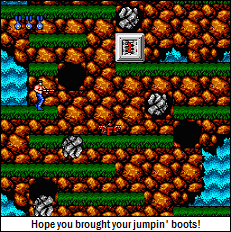 Well tough cookies son, because this game is going to take you to school. Contra practically defines hard. You might have infinite ammo, but you die in one hit. That's right: if anything touches you, you are dead. Like a real man. And the enemies are going to spawn infinitely at you, so don't think you can just sneak by the firefights as they come along. You let your guard down and you are jungle food, you hear me? And here's the great thing about it all: it's fair. I can't emphasize enough how absolutely critical that is to the gameplay experience. Contra is crazy hard and will test your memory and reflexes alike, but you will never complain of a cheap death. There's never going to be some glitchy pit or some unavoidable enemy to steal a life from you; if you die, it's on you. Take some responsibility for your failings. Like a real man.
 To that end, the game displays your current extra lives as medals in the upper left corner of the screen. But it won't display any more than four. It's like the developers didn't want to waste precious lines of code displaying something you'd never attain anyway. "You know you don't have that many lives, kid. Don't even argue." When you do inevitably die, you'll at least come back right where you were, with a few seconds of invincibility to get your bearings back. You'll lose any gun upgrades you acquired though, which can make it quite the uphill battle to make further progress. More on upgrades in a bit. For now I'd like to point out the image above and ask something in earnest: How the blazes is there an arctic forest on the same small island as a tropical jungle?! I saw that ice covering the ground and almost drenched my undies. As if the game weren't difficult enough without skidding all over the place. Blissfully, I needed worry not - your traction is unaffected. Contra doesn't need gimmicks to beat you. See? Tough, but fair. Like a real man.
 What, really? The bosses too?! Come on big robot man, you can do better than that! This guy is like the head general of the whole organization, and this little wimpkick is his only attack. Unless you count running into you at normal speed an attack. Is this what the Red Falcon terrorists do in their spare time? Just practice ballet? It's like that prison in the Phillipines that
  But who are we kidding, really? There's only one weapon you'll ever really want or need in Contra: the Spread Gun. It's so good I capitalized it. It's so good
 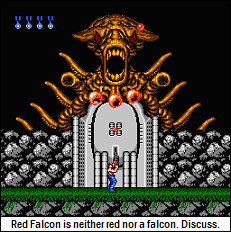 WHOA MY GOD THAT'S A BIG ALIEN! What's happened here?! My whole sense of reality is a-shambles. One minute I'm fighting terrorist forces in a frosty rainforest, and the next thing I know there are aliens barfing fireballs at me. Sad but true, it's our worst fears realized: alien-financed South American terrorism. Apparently Red Falcon isn't just the name of the organization; it's also the codename for the head alien itself, pulling all the strings. Of all the sneaky... But hey, I guess it all works out in the end, right? I mean, the developers were basically trying to make a video game that combined Rambo and Schwarzenegger's Predator, so mission accomplished. And when you destroy the alien hive, you get treated to a lovely cutscene of your single helicopter blowing up the entire island. Like a real man.